
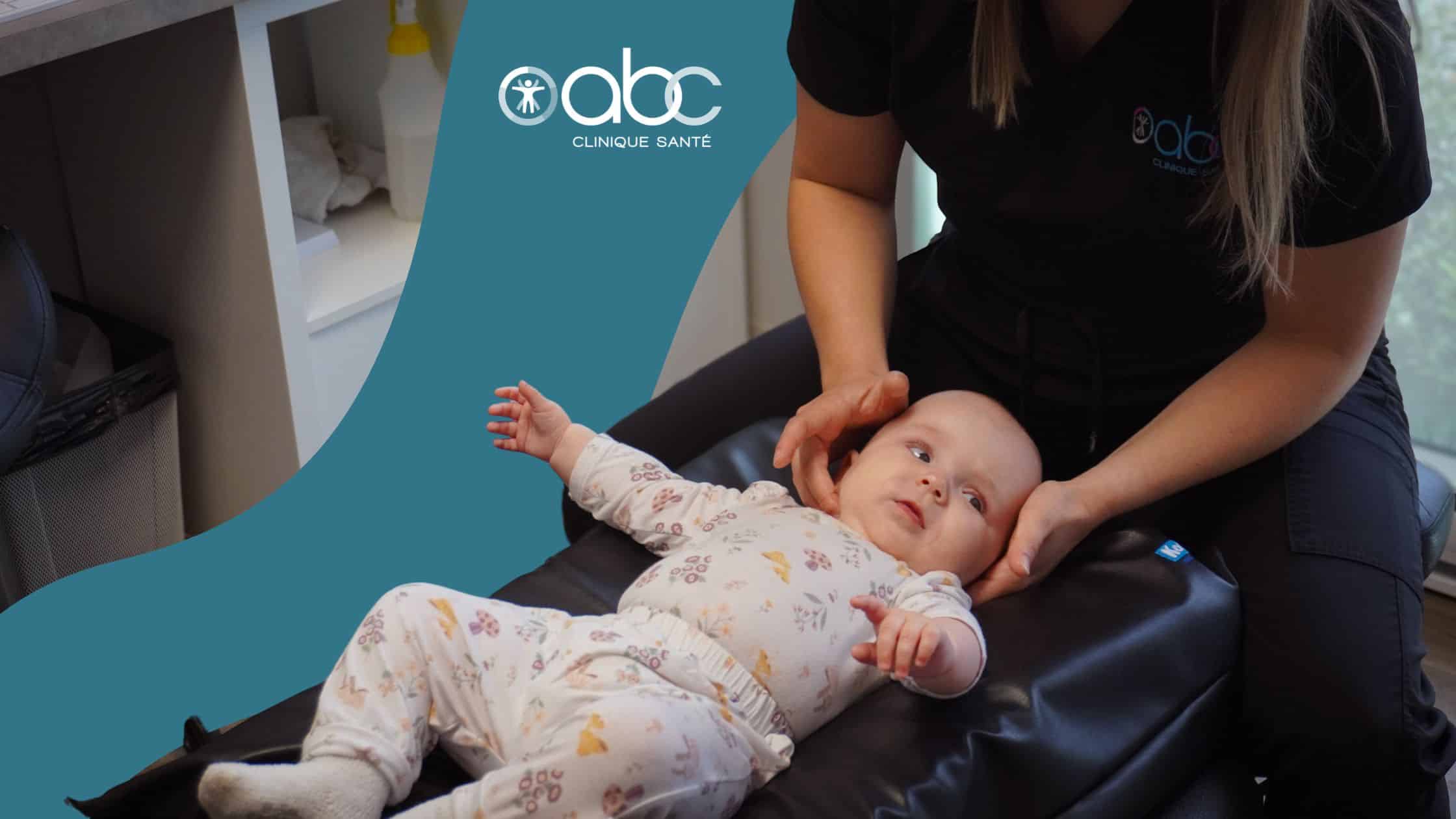
Have you noticed that your baby almost always turns their head to the same side? Does their head seem slightly tilted, or have you noticed a flatter area at the back of their skull? These observations can sometimes be associated with congenital torticollis or positional plagiocephaly.
These conditions are relatively common in infants and can sometimes be related to one another. Early assessment can help better understand your baby’s movement preferences and determine whether further care is needed.
What is congenital torticollis?
Congenital muscular torticollis is a condition in which a baby tends to hold their head in a particular position. Certain neck movements may also be limited or uncomfortable.
The first signs can be subtle. For example, you may notice that your baby:
- turns their head more easily to one side;
- frequently keeps their head tilted;
- seems to have more difficulty looking in one direction;
- becomes uncomfortable or cries when you gently try to move their head into a position they tend to avoid;
- has a different range of motion from one side to the other.
The severity of these signs can vary from one baby to another. A preference for one position does not necessarily mean that your baby has torticollis, but a persistent preference may warrant an assessment.
Why can a baby develop torticollis?
Several factors may contribute to the development of torticollis. In some cases, the baby’s position during pregnancy or mechanical factors around birth may play a role.
After birth, a persistent preference for looking in the same direction may also contribute to maintaining certain movement restrictions. This is why it can be helpful to pay attention to your baby’s head movements from the first few weeks of life.
What signs should you watch for?
As a parent, you are often the first person to notice that a movement or position seems different.
A persistent preference for one side is something to pay attention to. You can also observe how your baby moves their head when looking at you, playing, or lying on their back while awake.
Difficulties during breastfeeding or latching may also warrant attention. Some babies may be more comfortable latching on one side than the other.
However, these observations alone cannot establish a diagnosis. An assessment by a healthcare professional can help determine what may be contributing to the difficulties you have noticed.
What is plagiocephaly?
Positional plagiocephaly, sometimes referred to as a “flat head,” is an asymmetrical flattening of the skull that can develop when a baby’s head frequently remains in the same position.
It may present as:
- flattening on one side of the back of the skull;
- asymmetry in the shape of the head;
- a change in the shape of the forehead;
- an apparent difference in the position or height of the ears.
An infant’s skull is particularly malleable. Repeated pressure on the same area can therefore influence its shape. The Canadian Paediatric Society notes that mild flattening may correct itself over time, while more significant flattening may persist.
What is the connection between torticollis and plagiocephaly?
Torticollis and plagiocephaly can sometimes be associated.
When a baby has difficulty turning their head in one direction, they may spend more time with their head turned toward the same side. This preference can increase pressure on one area of the skull and contribute to the development or progression of positional plagiocephaly.
Conversely, a baby with plagiocephaly may also develop or maintain a preference for holding their head in a particular position.
This is why a comprehensive assessment of neck mobility, movement preferences, and skull shape can be helpful when one of these signs is observed.
What can you do at home to encourage your baby’s mobility?
Certain daily habits can help reduce the amount of time your baby spends in the same position while awake.
1. Tummy time
Tummy time, when your baby is awake and supervised, is an important part of infant motor development. It helps develop the muscles of the neck and upper body and can help reduce continuous pressure on the back of the skull.
Tummy time sessions do not all have to be long. Several short sessions throughout the day can add up.
If your baby becomes tired or uncomfortable, you can stop the session and try again later.
2. Vary positions during awake time
When your baby is awake, try to vary the positions in which you hold, interact and play with them.
You can also vary the side from which you talk to your baby or present interesting objects to naturally encourage them to look in different directions.
It is also recommended to limit prolonged periods in infant car seats, carriers and other equipment that keeps babies in a relatively fixed position when they are not necessary. The Canadian Paediatric Society recommends reducing sedentary time and prolonged periods in infant seats while babies are awake.
3. What about sleep?
Even when a baby has plagiocephaly, safe sleep remains a priority.
Your baby should always be placed on their back to sleep, on a firm, flat surface, in a safe sleep environment. Pillows, positioners and other accessories designed to keep your baby’s head in a particular position should not be used during sleep.
To naturally encourage your baby to look in different directions while lying on their back, you can instead vary their visual environment. For example, you can alternate the orientation of the crib or change where you position yourself when interacting with your baby.
The Canadian Paediatric Society recommends alternating your baby’s orientation in the crib to encourage them to look in different directions, while continuing to place them on their back for sleep.
When should you consult a healthcare professional?
If you notice that your baby:
- almost always turns their head to the same side;
- frequently keeps their head tilted;
- seems to have difficulty turning their head in one direction;
- cries or becomes uncomfortable when attempting certain movements;
- has flattening or asymmetry of the skull;
it may be appropriate to discuss these observations with a healthcare professional.
An assessment can help determine whether intervention is needed and, when appropriate, provide recommendations adapted to your baby’s age, abilities and individual needs.
Early assessment can make a difference
A baby’s development changes rapidly during the first few months of life. A movement preference noticed early should therefore be monitored rather than simply ignored.
At ABC Health Clinic, the assessment of infants can be part of an interdisciplinary approach when appropriate. The goal is to better understand your baby’s needs and direct you toward the appropriate resources or healthcare professionals.
Have you noticed a positional preference, difficulty turning your baby’s head, or asymmetry of their head? Talk to a healthcare professional to determine whether an assessment may be appropriate.
Visit the clinic nearest you:
-

Dre Emy Vignola, chiropractor
Chiropractor