
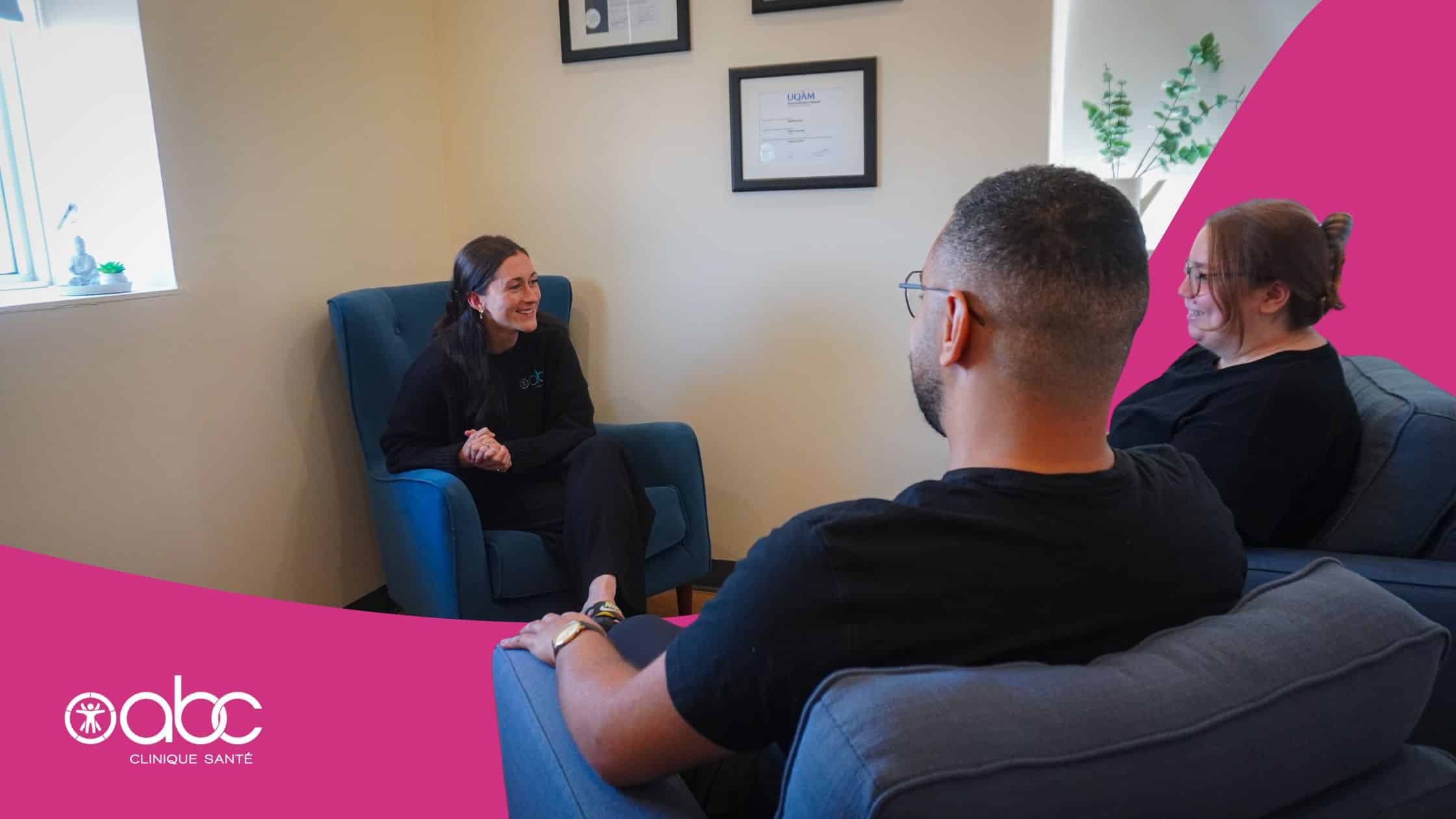
Couples therapy is often seen as a last resort. However, it is first and foremost a structured space designed to help couples better understand their relationship dynamics and develop practical tools to improve communication.
According to Jasmine, a sex therapist and psychotherapist at ABC Health Clinic Valleyfield, most couples who seek therapy aren’t lacking in love, but rather in effective strategies for understanding one another and managing conflicts.
Why do relationship conflicts keep coming back?
In most counseling sessions, communication issues are the top reason for seeking help. Couples often describe recurring situations:
- discussions that go in circles
- tensions that escalate quickly
- frequent interruptions
a feeling of not being heard - These conflicts often arise from mundane everyday situations (household chores, being late, family logistics), but it’s usually not the issue itself that’s the problem.
What’s really at stake is the way we communicate.
Metacommunication: A Key Tool in Couples Therapy
A central concept in couples therapy is that of metacommunication.
It involves:
talking about how we communicate, rather than the problem itself.
In practical terms, this means being able to say:
- “I feel like you’re not listening to me.”
- “I’m getting more and more frustrated with this conversation.”
- “We’re just going around in circles right now.”
This kind of exchange helps break the deadlock and return to more constructive communication.
Why is it hard to change on your own?
Even with the best intentions, it is often difficult for a couple to identify their own patterns. In therapy, the therapist’s role is to observe behaviors that partners may not always notice themselves, such as a tendency to interrupt, raised voices in certain situations, disproportionate emotional reactions, or repetitive patterns that develop over time.
This observational work then allows for the development of concrete relationship skills, which are essential for sustainably improving communication within the couple.
Relationship Dynamics: Understanding Couple Patterns
A common focus in therapy is identifying relationship patterns.
A classic example is the “pursuer/avoider” dynamic (or “approach-withdrawal”)
- One person feels the need to talk immediately to resolve the conflict
- The other prefers to take a step back and be alone
Both of these reactions are understandable… but when combined, they create a vicious cycle:
- The more one person pushes → the more the other withdraws
- The more the other withdraws → the more one person pushes
The result: the conflict escalates instead of being resolved.
Where do these reactions come from?
These behaviors are not random. They are often linked to past experiences, emotional wounds, and learned relationship patterns.
For example:
- one person may associate conflict with fear and want to flee
- another may associate distance with abandonment and seek to get closer
Therapy allows you to explore these origins in a safe and supportive environment.
The goal: healthier and more productive communication within a relationship
The goal isn’t to eliminate conflicts—they’re a natural part of any relationship.
Rather, the goal is to:
- better understand your own reactions
- recognize the other person’s reactions
- express your emotions clearly
- break out of repetitive patterns
With the right tools, a conversation can shift from:
“You never do this right”
to:
“Right now, I’m feeling frustrated and I feel like I’m not being understood”
This shift completely changes the dynamic.
When Should You Seek Couples Therapy?
It may be a good idea to seek therapy when the same conflicts keep recurring and discussions become unproductive or exhausting. Some couples also feel a sense of distance gradually setting in, or the impression of being “stuck in a loop” where the same situations repeat themselves without a lasting solution.
Therapy can also be beneficial as a proactive measure, simply to improve communication and strengthen the relationship before difficulties escalate.
A gradual but lasting approach
Understanding the dynamics of a relationship doesn’t happen in a single session.
On average:
- several sessions are needed to fully assess the situation
- the work then continues to help you incorporate new tools
But this process enables profound and lasting changes in the relationship.
Need some guidance?
Couples therapy helps you better understand conflicts, identify the relationship dynamics at play, and develop more effective communication tools, all with the goal of building a stronger foundation for your relationship.
If you recognize some of these patterns in your relationship, professional support can make a real difference. Jasmine Farmer, a sex therapist and psychotherapist at ABC Health Clinic in Valleyfield, offers support tailored to each couple’s unique situation, in a caring and structured environment.
Don’t hesitate to reach out to start making real changes.
-

Jasmine Farmer
Sexologist and psychotherapist